A Round Dial Smartwatch can give a product line a familiar, premium appearance. Its circular screen resembles a traditional wristwatch, while fitness tracking, notifications, and health features support daily use. For global sourcing teams, this balance can improve market appeal across different age groups and retail channels.
In supplier evaluations, appearance is only one part of the decision. Buyers should inspect display brightness, touch accuracy, battery performance, strap quality, and companion-app stability. A sample may look impressive under showroom lighting but perform poorly outdoors. Real testing matters. Check it carefully.
Experienced sourcing teams should request component details, firmware information, inspection records, and clear warranty terms. They should also confirm packaging language, charger specifications, wireless functions, and market documentation for each destination. Requirements differ by country and sales platform, so assumptions can create avoidable delays. Reliable suppliers usually provide consistent samples, traceable production details, and responsive technical support.
A round design does not guarantee commercial success. Some users prefer larger rectangular displays for reading messages. Others may find circular layouts less efficient for text-heavy applications. Battery life can also vary with screen brightness, sensors, and software updates. These limitations deserve honest review.
For this reason, global buyers should compare several models, test pre-production units, and collect feedback from target users. Price is important, but stable quality often protects margins better. The right Round Dial Smartwatch is not simply attractive. It should match customer expectations, sourcing capabilities, and long-term product plans.
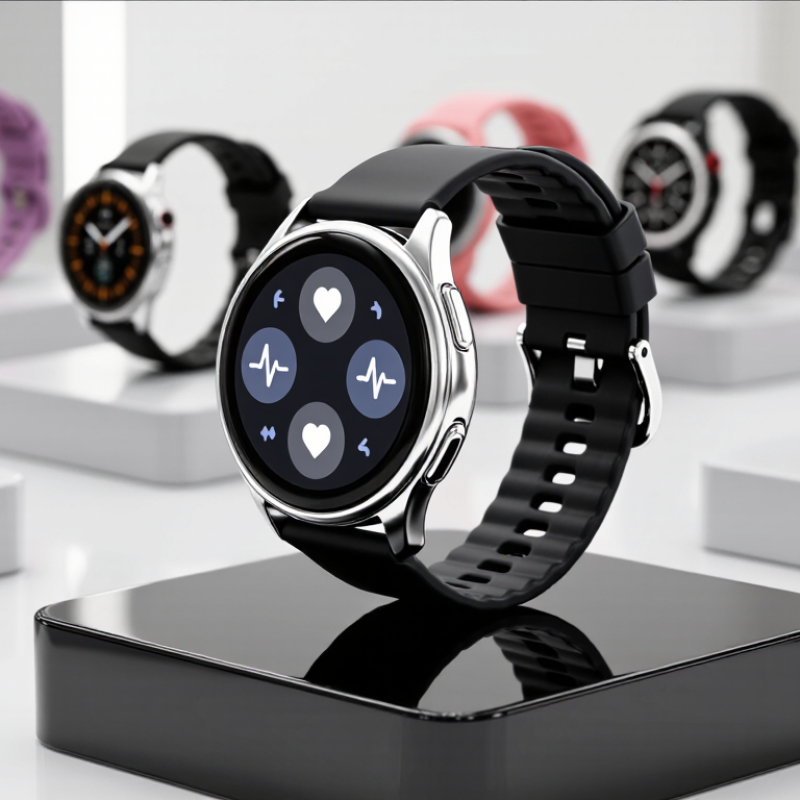
Understanding the Design and Functions of Round Dial Smartwatches
Round dial smartwatches combine familiar watch proportions with connected functions.
Their circular display supports a traditional visual language, which can improve acceptance in conservative markets. Case diameter, bezel width, and lug shape strongly affect comfort. A 42-millimeter case may suit many wrists, but smaller users may prefer 38 to 40 millimeters. The compromise is real.
Function design matters more than appearance.
A sourcing team should examine touch accuracy, screen brightness, battery capacity, and charging stability. Health features may include heart-rate tracking, sleep monitoring, step counting, and blood-oxygen estimation. These functions require reliable sensors and clear user instructions. According to the International Data Corporation’s Worldwide Quarterly Wearable Device Tracker, global wearable shipments reached about 537.6 million units in 2024, showing strong demand for compact connected devices. However, shipment growth does not guarantee long-term user satisfaction.
For global sourcing, suppliers should provide display specifications, water-resistance test results, battery-cycle data, and software update policies.
A round screen can make text alignment attractive, yet some menus waste space near the edges. This design weakness is easy to overlook. The Consumer Technology Association’s 2024 U.S. Consumer Technology Ownership and Usage Study also reported widespread ownership of smartwatches and fitness trackers, reinforcing the need for dependable daily functions. Buyers should test the watch with wet fingers, outdoor light, and repeated wrist movement. Laboratory results alone are not enough.
Comparing Round Dials with Other Smartwatch Shapes
Why Choose a Round Dial Smartwatch for Global Sourcing?
Round and square smartwatches serve different buying expectations. Round dials resemble traditional watches, which can improve acceptance in formal and outdoor markets. Square screens often display messages and health metrics more efficiently. That matters for users who read notifications frequently. According to Grand View Research, the global smartwatch market was valued at approximately $33.6 billion in 2023. Its forecasted growth also suggests strong demand for varied designs, not one universal shape.
For sourcing teams, round cases can simplify product positioning across regions. A 42–46 millimeter case may suit both office wear and active use. However, round displays often waste corner space when showing text, maps, or workout data. Square designs usually offer better content density and may reduce interface redesign costs. Counterpoint Research reported a decline in global smartwatch shipments during 2024, making practical differentiation more important. A distinctive case shape alone may not protect margins.
I have seen buyers favor round models because customers understand them quickly. Yet that preference can become a weakness when small text feels cramped. Case thickness, bezel width, button placement, and strap availability deserve equal testing. These details affect comfort more than shape in daily use. Global sourcing should compare tooling costs, screen yields, packaging size, and regional style preferences. The best decision may be a hybrid one. Sometimes, less traditional wins. Industry forecasts are useful, but supplier samples still reveal problems that spreadsheets miss.
Why Choose a Round Dial Smartwatch for Global Sourcing?
At the same external width and height, a round display provides approximately 78.5% of the bounding-box area, while square and rectangular displays can use nearly 100%. Round dials remain attractive for traditional watch styling, visual differentiation, and compatibility with classic analog-inspired interfaces.
Evaluating Global Market Demand and User Preferences
Global demand for round dial smartwatches is shaped by more than appearance. Buyers often associate the circular display with traditional watches, making it easier to accept in formal workplaces and daily routines. In supplier discussions, purchasing teams frequently ask about screen brightness, battery endurance, water resistance, and strap comfort. These details influence repeat orders more than novelty features.
User preferences vary across regions. Urban professionals may prefer slimmer cases and quiet vibration alerts. Outdoor users often value stronger glass, readable numbers, and physical buttons. In some markets, consumers favor health tracking, while others prioritize messages, payments, or simple timekeeping. Local surveys and retailer feedback should guide product decisions. Assumptions can be expensive.
A reliable sourcing review should compare sample quality, software language support, packaging, and after-sales capacity. Testing several wrist sizes can reveal uncomfortable edges or loose sensors. Small flaws matter. Suppliers should provide clear technical data and consistent inspection records. They also need to explain how personal data is protected and how product documentation meets destination-market requirements. A round dial may attract attention, but poor comfort can weaken demand quickly. Market evidence is useful, yet never complete. Preferences change faster than many forecasts.
Conclusion
Choosing a Round Dial Smartwatch for global sourcing requires balancing appearance, functionality, market appeal, and supply chain practicality. Its circular display offers a familiar, classic look while supporting essential features such as fitness tracking, notifications, health monitoring, wireless connectivity, and customizable interfaces. Compared with square or rectangular designs, the round format may attract consumers who prefer traditional watch aesthetics, although screen layout and app compatibility should be evaluated carefully. Understanding regional preferences and demand trends can help buyers select the right specifications, sizes, materials, and feature combinations for different markets.
Sourcing decisions should also consider total cost, supplier capabilities, minimum order quantities, customization options, and production timelines. Buyers need to verify product quality through sample testing, durability checks, battery performance reviews, software compatibility assessments, and reliable communication standards. In addition, suppliers should provide appropriate documentation for market entry, packaging, labeling, and shipping requirements. A careful evaluation of these factors can reduce sourcing risks and support the successful development of a competitive Round Dial Smartwatch for international distribution.