
China has become a major sourcing base for Open-Ear OWS Earclips, supported by mature audio-component supply chains and flexible electronics manufacturing. Shenzhen, Dongguan, and Guangzhou host suppliers covering acoustic tuning, Bluetooth modules, injection molding, and final assembly. This concentration can shorten development cycles, but factory capability still varies widely.
Market evidence supports this category’s momentum. Grand View Research’s recent open-ear headphones analysis identifies growing demand for comfort, situational awareness, and lightweight wearable audio. Canalys’ global hearables research also shows that consumers continue adopting wireless audio products beyond traditional in-ear designs. These reports indicate opportunity, not guaranteed success. Product quality remains decisive.
Look closely.
This guide examines leading Chinese manufacturers through practical purchasing criteria. These include acoustic performance, microphone clarity, Bluetooth stability, battery endurance, IP testing, material quality, and production consistency. SGS, TÜV, or equivalent laboratory documentation can strengthen supplier credibility, although certificates should be verified against the exact model. A polished sample proves little if mass production changes its speaker balance or charging contacts.
The best Open-Ear OWS Earclips manufacturers should provide traceable quality-control records, realistic lead times, transparent minimum order quantities, and responsive engineering support. Buyers should request sample testing in noisy streets, offices, and light exercise settings. A product that sounds impressive in a quiet showroom may perform differently outdoors. That is an easy mistake.
This overview therefore focuses on manufacturers with verifiable experience, technical depth, and export readiness. Supplier rankings may change as factories upgrade equipment, develop new designs, or lose consistency. Careful evaluation remains necessary.
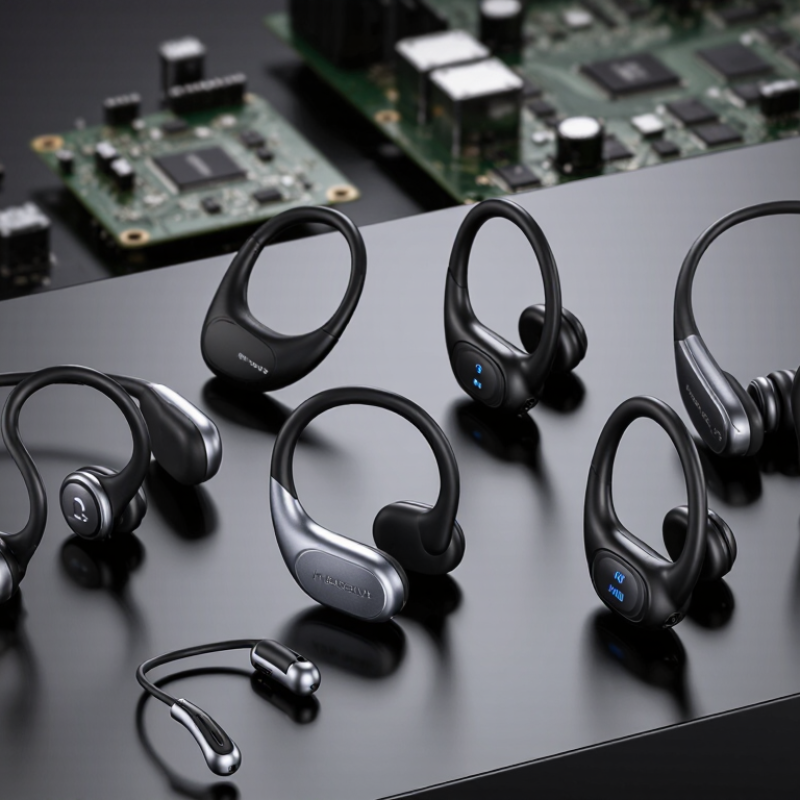
Open-ear OWS earclips are wearable speakers that rest beside the ear, rather than sealing the ear canal. Their small transducers send sound toward the ear opening through air conduction. The clip provides gentle mechanical support around the outer ear. Users can hear music while noticing traffic, conversations, or a ringing doorbell.
This design differs from traditional in-ear products. It reduces the plugged-ear feeling, but bass may sound lighter in noisy streets. Acoustic leakage can also disturb nearby people. According to Canalys’ 2024 global personal audio report, the wider true-wireless market continued growing, while comfort and everyday awareness remained important buying factors. Grand View Research also identifies open-ear audio as a fast-expanding segment, supported by sports, commuting, and workplace use. These figures describe market direction, not guaranteed product quality. Fit still matters more than impressive packaging.
Tips: Check the earclip after ten minutes. It should stay stable without pressing the cartilage. Test calls in wind and beside traffic. A clear voice matters more than maximum volume. Look for measured battery life, Bluetooth stability, water resistance ratings, and published acoustic testing. China-based manufacturers often offer flexible tooling and fast sampling, but buyers should request independent test reports. OWS earclips are useful, not flawless. Their open structure improves awareness, yet it cannot replace careful listening habits.
China-based OWS earclip manufacturers are gaining attention for combining open-ear comfort with practical production control. Leading factories usually offer molded earclips, directional speakers, and lightweight frames suited to long listening sessions. Their engineers test clamp pressure on different ear shapes, not only on standard samples. This matters during a three-hour commute. Comfort comes before maximum loudness.
Strong manufacturers maintain in-house acoustic tuning, battery testing, and assembly inspection. They measure sound leakage, microphone clarity, charging stability, and wireless connection performance. A reliable supplier should provide test records, sample revisions, and traceable component information. Production teams may also support custom colors, logo placement, packaging, and small pilot orders. Clear communication reduces costly changes after tooling begins.
Factory visits or third-party audits can reveal details that brochures miss. Check soldering quality, dust control, aging tests, and how rejected units are handled. Some suppliers promise very low defect rates, yet their inspection methods may remain unclear. That deserves questions. Earclip pressure can also vary between batches if flexible materials are poorly controlled. Engineers should compare samples from separate production runs, then review fit, call quality, and battery endurance in real use. A polished prototype is not enough. Reliable cooperation grows through records, repeat testing, and honest correction when a design still needs work.
China Top Open-Ear OWS Earclips Manufacturers?
How China’s OWS Earclip Manufacturing Process Works
In China, OWS earclip production usually begins with product validation, not mass assembly. Engineers review the ear contour, speaker position, battery space, and charging requirements. They create several 3D-printed samples before cutting production molds. This practical step exposes pressure points behind the ear. It also reveals whether sound leaks excessively in quiet rooms.
Factories then mold the earclip shell from skin-friendly plastics or flexible elastomers. Incoming material checks measure color, hardness, moisture, and dimensional stability. Operators inspect each molded part for flash, sink marks, and uneven edges. Small defects matter. They can create discomfort after extended wear. The acoustic module is assembled separately, with the driver aligned toward the ear canal without sealing it. Automated dispensing controls adhesive volume around the speaker and battery.
During final assembly, workers connect the circuit board, microphone, battery, and touch controls. Functional testers check wireless pairing, charging current, microphone clarity, and left-right channel balance. Samples also undergo sweat exposure, button-cycle testing, drop checks, and repeated clip opening. Quality teams record serial data for traceability. In my experience, visual inspection alone is not enough. A polished sample may still fail after thermal cycling. Some factories improve fixtures after pilot runs, while others move too quickly and repeat alignment errors. That weakness deserves attention. Reliable manufacturers compare pilot results with production data and correct tooling before larger orders proceed.
| Manufacturing Dimension | Typical Process or Specification | Purpose in OWS Earclip Production | Common Quality-Control Check |
|---|---|---|---|
| Product Architecture | Open-ear, non-sealing design using a directional speaker positioned near the ear canal | Delivers audio without fully blocking the ear canal and allows awareness of surrounding sounds | Acoustic output, sound leakage, wearing stability, and listening comfort |
| Industrial Design | 3D CAD modeling followed by prototype samples and fit evaluation | Defines the earclip shape, component arrangement, appearance, and assembly clearances | Dimensional inspection, prototype fit tests, hinge or clip movement, and visual review |
| Earclip Material | Flexible polymer, silicone contact surfaces, or a formed metal core with protective overmolding | Balances flexibility, durability, weight, skin contact comfort, and retention force | Material identification, hardness, surface defects, and repeated flexing performance |
| Housing Fabrication | Precision injection molding for plastic housings, with secondary trimming and surface finishing | Creates lightweight shells that protect the speaker, battery, PCB, and wireless components | Molded dimensions, parting-line quality, sink marks, flash, color consistency, and fit |
| Acoustic Module | Assembly of a miniature speaker, acoustic cavity, protective mesh, and sealing or damping elements | Controls frequency response, clarity, efficiency, and sound direction | Frequency-response testing, distortion testing, polarity verification, and abnormal-noise screening |
| Printed Circuit Board | Surface-mount assembly of the Bluetooth system-on-chip, power-management IC, amplifier, and passive components | Provides wireless communication, audio processing, power regulation, and control functions | Automated optical inspection, solder-joint inspection, programming, and functional testing |
| Battery Integration | Installation of a rechargeable lithium-ion or lithium-polymer cell with protection circuitry | Supplies portable power while protecting against overcharge, over-discharge, and short circuit conditions | Voltage, capacity, charging behavior, polarity, insulation, and protection-function checks |
| Wireless Configuration | Firmware loading, Bluetooth pairing configuration, button or touch-control mapping, and audio calibration | Ensures the earclips operate correctly with compatible host devices and intended controls | Pairing reliability, connection stability, latency, firmware version, and control response |
| Microphone Assembly | Installation of one or more MEMS microphones with acoustic ports and protective mesh | Supports voice calls, voice assistants, and environmental-noise processing | Microphone sensitivity, channel balance, port obstruction, and call-quality testing |
| Earclip Assembly | Mechanical and electrical joining of the clip, housing, speaker, PCB, battery, microphones, and flexible cables | Creates the complete wearable unit while maintaining compact packaging and cable protection | Connector seating, cable routing, screw or adhesive application, and assembly alignment |
| Adhesive and Sealing | Controlled dispensing of adhesives, gaskets, or sealants followed by curing where required | Improves structural strength, vibration resistance, and protection from dust or moisture | Dispensing volume, cure condition, bond strength, and enclosure integrity |
| Charging Case Integration | Assembly of charging contacts, magnets, USB charging hardware, battery, and case electronics | Stores, protects, and recharges the earclips between uses | Contact alignment, charging current, case battery behavior, lid movement, and magnetic retention |
| Functional Testing | Automated and manual tests covering power, charging, Bluetooth, controls, microphones, speakers, and sensors | Detects electrical, acoustic, firmware, and assembly defects before shipment | Test records, pass/fail traceability, and controlled rework procedures |
| Reliability Validation | Battery cycling, charging-cycle testing, repeated clip flexing, button-life testing, vibration, and temperature-humidity exposure | Evaluates durability during expected transportation and everyday use | Performance before and after testing, cosmetic inspection, and failure analysis |
| Safety and Compliance | Assessment against applicable requirements for radio equipment, batteries, electromagnetic compatibility, and restricted substances | Supports lawful market entry and reduces risks related to radio, chemical, and battery safety | Technical documentation, laboratory reports, labeling review, and production consistency checks |
| Final Inspection and Packing | Cosmetic inspection, accessory verification, serial or lot recording, cleaning, and protective packaging | Prepares finished OWS earclips for warehousing, transportation, and customer delivery | Appearance, quantity, package contents, charging accessories, manuals, labels, and carton condition |
Comparing Chinese OWS earclip suppliers requires more than checking unit prices. Start with the acoustic design. Ask how engineers control sound leakage, vocal clarity, and bass response without sealing the ear canal. Request measured frequency charts and real sample recordings. A supplier that explains testing conditions earns more trust than one offering only impressive numbers.
Fit is equally important. Examine clamp force, silicone contact areas, hinge durability, and weight distribution. Wear each sample for at least two hours. A comfortable clip should not create pressure behind the ear. Check performance during walking, office calls, and outdoor wind. Small details matter, such as button stiffness and microphone placement. Many suppliers provide attractive samples, but mass production may feel different.
Review the factory’s quality process carefully. Look for incoming material checks, battery safety records, acoustic inspection, aging tests, and final assembly sampling. Ask for production photos, inspection reports, and clear replacement procedures. Confirm tooling ownership, minimum order quantities, lead times, packaging options, and communication frequency. A practical supplier should explain problems early, not hide them.
Do not depend on certificates alone. Some documents may be outdated or unrelated to the exact model. An independent pre-shipment inspection can reveal loose hinges, uneven charging contacts, or inconsistent volume. I have also found that the cheapest quotation can create higher costs later. My comparison sheets are useful, but they still miss factory culture and daily discipline. One supplier may look perfect on paper, yet respond slowly when a small defect appears. That weakness deserves attention.
When choosing a China OWS earclip manufacturer, do not judge capability from polished product photos alone. Request a factory video, production address, and live sample review. A reliable supplier should explain driver size, battery capacity, Bluetooth testing, and skin-contact materials clearly. Ask for recent quality records, not vague promises.
Test the earclips on different ears. Comfort changes with ear shape, clip pressure, and frame weight. In our sourcing experience, a five-minute fit check can miss discomfort after two hours. Request samples from separate production batches.
Compare charging contact alignment, microphone clarity, hinge strength, and left-right volume balance. Small details matter. Also inspect packaging protection and moisture control during shipping.
A capable manufacturer should provide traceable component information, inspection standards, and realistic production timelines. Ask for applicable safety and radio compliance reports for target markets. Confirm defect handling before placing an order. Clarify sample fees, tooling ownership, minimum order quantity, and replacement procedures in writing. Be careful with unusually low quotations; they may hide weaker batteries or inconsistent assembly. Still, documents are not proof by themselves. An audit can overlook a rushed line, and a sample can be unusually good. Ask practical questions, keep test records, and allow time for one corrective production round.
They are wearable speakers resting beside the ear. Small transducers send sound through open air. The ear canal remains unsealed.
A clip gently supports the outer ear. Silicone contact areas can improve comfort. Check the fit after ten minutes.
Yes, the open design allows traffic, conversations, and doorbells to remain noticeable. Awareness is improved, not guaranteed.
Bass may sound lighter in noisy streets. Sound leakage can disturb nearby people. Open designs are useful, but imperfect.
Wear each sample for at least two hours. Walk, sit, and make calls. It should not press the cartilage.
Check measured battery life, Bluetooth stability, water resistance, and acoustic testing. Test microphones in wind and beside traffic.
Review acoustic charts, sample recordings, clamp force, hinge strength, and weight distribution. Cheap quotations may create later costs.
Ask about battery records, material inspections, aging tests, and final assembly sampling. Request independent pre-shipment inspection when possible.
No. Documents may be outdated or unrelated to the exact model. Daily factory discipline is harder to measure.
Open-Ear OWS Earclips are lightweight audio devices that rest around the ear and direct sound toward the listener without sealing the ear canal. This design supports greater awareness of surrounding sounds while providing comfortable listening for calls, music, and daily activities. Leading China-based manufacturers typically focus on ergonomic earclip structures, stable wireless performance, clear audio output, long battery life, reliable charging systems, and practical water or sweat resistance. Their product development often combines industrial design, acoustic tuning, electronic assembly, software integration, and quality testing.
The manufacturing process generally includes concept development, prototype evaluation, component sourcing, circuit assembly, acoustic calibration, appearance inspection, functional testing, and final packaging. When comparing Chinese OWS earclip suppliers, buyers should assess production capacity, customization support, quality-control procedures, communication efficiency, lead times, certifications, sample performance, and after-sales service. Choosing the right Open-Ear OWS Earclips manufacturer requires balancing product quality, technical capability, pricing, delivery reliability, and the supplier’s ability to support consistent large-scale production.