
Choosing a Metallic Strap Smartwatch is not simply a style decision. It involves comfort, durability, software support, battery life, and long-term value. A polished stainless-steel bracelet may look excellent under office lighting, yet feel heavy during a morning run. That contrast matters.
The global wearable device market shipped approximately 537.2 million units in 2024, according to IDC’s Worldwide Quarterly Wearable Device Tracker. Counterpoint Research also reported a decline in global smartwatch shipments during 2024, showing that buyers are becoming more selective. These figures suggest a practical question: does the metallic finish add genuine daily value, or only visual appeal?
Avi Greengart, founder of Techsponential, has described smartwatches as “small computers on your wrist.” His observation supports a wider buying principle: the case and strap should serve the technology, not disguise its limitations. Buyers should inspect clasp security, removable links, wrist weight, skin contact, and water resistance. They should also check whether replacement straps are widely available.
Looks can mislead.
A metallic strap may scratch beside a laptop, pinch arm hair, or become uncomfortable in humid weather. I have also found that some attractive models offer weak health software or short battery endurance. That is easy to overlook in a showroom.
This guide compares materials, fit, sensors, operating systems, charging routines, and real ownership costs. It also questions the assumption that premium appearance always means premium performance. Reports from IDC and Counterpoint Research provide market context, while hands-on evaluation remains essential. The best Metallic Strap Smartwatch is not necessarily the heaviest or brightest model. It is the one that remains comfortable, useful, and dependable after the novelty fades.
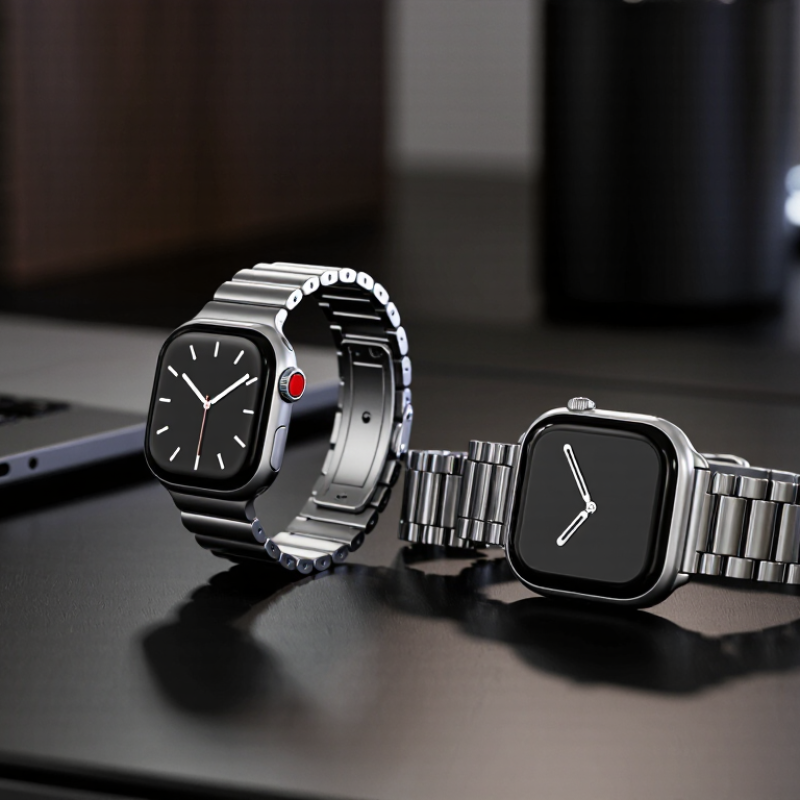
Define your daily use before choosing a metallic strap smartwatch. A 24-hour battery target suits basic notifications, step tracking, and occasional calls. It requires charging almost every night. That routine may become annoying. I learned this after leaving my charger beside a hotel bed.
Choose 48 to 72 hours for commuting, office work, and weekend activities. This range gives useful protection when charging is delayed. Frequent GPS workouts, bright screens, and continuous heart-rate monitoring can reduce battery life quickly. A stated three-day rating may reflect laboratory settings, not your busy Tuesday. Check independent tests and read the manufacturer’s conditions carefully. Battery estimates are not promises.
A seven-day target fits travelers, hikers, and people who dislike daily charging. However, longer endurance often means fewer advanced features or slower data updates. Consider how the metallic strap affects real use, too. It can feel polished at work but heavy during running. Measure your wrist and test the clasp before buying. A loose fit can weaken health readings and cause skin irritation. I once prioritized appearance and ignored comfort; the watch stayed in a drawer. Small compromises matter. Think about charging time, replacement strap availability, and whether the charger is easy to carry. A reliable choice should match your actual schedule, not an ideal version of it.
How to Choose a Metallic Strap Smartwatch?
Weight changes the wearing experience more than many buyers expect. ASM International’s Metals Handbook lists approximate densities of 7.9–8.0 g/cm³ for 316L stainless steel and 4.43 g/cm³ for Grade 5 titanium. For the same case volume, titanium can reduce material weight by about 44%. On the wrist, that difference feels noticeable during sleep, running, or long office hours. It also makes a titanium bracelet easier to lift, although the clasp and strap design still affect total mass.
Corrosion resistance needs closer judgment. 316L relies on chromium-rich passivation, while titanium Grade 5 forms a stable oxide film almost immediately. The ASM Handbook describes titanium as highly resistant to seawater and many chlorides. For 316L, the PREN estimate usually falls near 24–27, using chromium, molybdenum, and nitrogen content. Higher values generally improve pitting resistance, but they do not guarantee perfect performance. Sweat, trapped salt, and damaged surfaces can still create stains or localized attack.
Here is the less comfortable detail. ASTM G48 testing shows that pitting behavior depends strongly on temperature, chloride concentration, and exposure time. ASTM B117 salt-spray results also should not be treated as direct predictions of daily wear. A titanium strap may resist corrosion better, yet its surface can show scratches more clearly. A 316L strap feels heavier but often offers a denser, more substantial touch. My first assumption was that titanium always wins; real wear is less simple. Fit, cleaning habits, and contact with other metals deserve equal attention.
| Comparison Dimension | 316L Stainless Steel | Grade 5 Titanium |
|---|---|---|
| Material designation | Austenitic stainless steel, commonly specified as UNS S31603 when referring to low-carbon 316L. | Titanium alloy Ti-6Al-4V, containing approximately 6% aluminum and 4% vanadium by weight. |
| Density | Approximately 7.99 g/cm³ | Approximately 4.43 g/cm³ |
| Weight for the same volume | Reference value: 100% | Approximately 55.4% of the mass of 316L steel |
| Potential weight reduction | Reference value: 0% | Approximately 44.6% lighter for an identical solid volume |
| Typical tensile strength | Commonly around 515 MPa minimum in annealed product specifications; actual values depend on product form and processing. | Commonly around 895 MPa minimum in annealed product specifications; actual values depend on product form and processing. |
| Strength-to-weight advantage | Good general-purpose strength, but its higher density increases wrist weight. | Excellent: high strength combined with substantially lower density. |
| Corrosion mechanism | Protected by a chromium-rich passive film. Molybdenum improves resistance to localized chloride corrosion compared with common 304 stainless steel. | Protected by a highly stable titanium oxide film that reforms rapidly when exposed to oxygen. |
| Resistance to sweat and everyday moisture | Generally very good, although prolonged exposure to sweat, salt, dirt, and trapped moisture can increase the risk of staining or localized corrosion. | Excellent: highly resistant to perspiration, humidity, and most everyday atmospheric exposure. |
| Chloride and seawater exposure | Good resistance, but pitting or crevice corrosion can occur in warm, concentrated, or stagnant chloride environments. | Excellent resistance in seawater and chloride-rich environments under normal conditions. |
| Important chemical limitations | Can be attacked by strong acids, aggressive chlorides, and galvanic contact with dissimilar metals in wet conditions. | Can be attacked by hydrofluoric acid, fluoride-rich chemicals, and some hot, strongly reducing acid environments. |
| Surface appearance | Naturally bright, silver-colored, and easy to produce with polished, brushed, or bead-blasted finishes. | Darker gray or silver-gray appearance; commonly used with brushed, blasted, or coated finishes. |
| Best choice for a smartwatch strap | Choose 316L when a classic metallic appearance, lower material cost, and substantial feel are more important than minimum weight. | Choose Grade 5 titanium when low weight, high strength-to-weight ratio, and maximum resistance to sweat and salt exposure are priorities. |
Note: Material properties are typical reference values. The final weight, comfort, corrosion performance, and surface durability of a smartwatch strap also depend on link design, wall thickness, coatings, fasteners, machining, and maintenance.
How to Choose a Metallic Strap Smartwatch?
A metallic strap smartwatch should match your daily contact with water. ISO 22810 ratings help, but they are not simple diving-depth promises. A 3 ATM watch withstands laboratory pressure similar to 30 meters. That does not mean it can safely travel 30 meters underwater. Splashing, movement, temperature changes, and aging seals create different pressure.
3 ATM suits hand washing, rain, and accidental spills. It is a cautious choice for office wear. Avoid showers and swimming with this rating. A 5 ATM watch offers stronger everyday protection. It may handle rain, washing, and some surface swimming, if the maker allows it. Check the official instructions before entering a pool. Water resistance can decline after impacts or repairs.
A 10 ATM rating provides more confidence for frequent swimming and water sports. It still is not a substitute for a diving-rated instrument. Salt water and chlorine can stain or weaken a metallic strap over time. Rinse the watch with fresh water, then dry it with a soft cloth. Keep the crown and buttons fully closed.
I once assumed 5 ATM meant worry-free swimming. That assumption was too casual. Seals wear quietly, and a polished case can hide damage. Choose the rating for your real habits, not an impressive number. A reliable fit also matters, because a loose strap may strike the case against hard surfaces.
ISO 22810 water-resistance ratings indicate the nominal pressure used during laboratory testing. A 3 ATM watch is generally intended for everyday splashes, a 5 ATM watch is commonly suitable for surface swimming, and a 10 ATM watch provides greater pressure tolerance for swimming and snorkeling. These ratings do not certify a smartwatch for scuba diving; diving watches are covered by ISO 6425.
A polished metallic strap looks premium, but smart features determine daily value. Bluetooth 5.3 can improve connection efficiency and reduce dropouts. However, version numbers alone do not guarantee smooth pairing. Check supported profiles, phone operating systems, call controls, and update policies. Bluetooth SIG’s 2024 Market Update forecasts annual Bluetooth device shipments will reach 7 billion by 2028, showing how important compatibility has become.
GPS deserves a practical test. Look for independent positioning, multiple satellite systems, and stable tracking near tall buildings. A watch that takes two minutes to locate you may frustrate runners. NFC is useful for contactless payments, transit access, or quick pairing, but availability depends on region and service support. Confirm the function before buying. IDC’s Worldwide Quarterly Wearable Device Tracker recorded 537.9 million wearable shipments in 2024, an 11.7% year-over-year increase, so more devices now compete on connected convenience.
Sensor compatibility matters just as much. Check whether heart-rate, blood-oxygen, temperature, and motion sensors work with your phone’s health platform. Review data export options, not only the number of sensors. More sensors can still mean poor readings. They are not medical diagnoses. I would also test accuracy during walking, sleep, and cycling, because one perfect showroom reading proves little. Metallic straps can feel heavy, too. A short trial may change your mind.
A metallic strap smartwatch should sit securely without pinching your wrist. Start by checking the lug width, measured between the inside edges of the watch lugs. Common options are 20 mm and 22 mm. The difference seems small, but it matters. A 20 mm strap usually will not fit a 22 mm case correctly. A loose spring bar can create movement, scratches, or accidental detachment.
Use a digital caliper when possible. A ruler can work, but its reading may be less precise. Also check the strap’s end links, spring-bar diameter, and taper. The listed width may describe only the lug connection, not the clasp or bracelet width. This detail is easy to miss. I once selected the correct lug width but ignored the end-link shape, leaving a visible gap beside the case.
Micro-adjustment is equally important. Look for several small clasp positions, ideally offering a few millimeters of fine adjustment. Your wrist may expand during exercise or warm weather. A bracelet that fits perfectly in the morning can feel tight later. Removable links provide larger changes, while micro-adjust holes handle daily comfort. Test the clasp with one finger inserted under the bracelet. It should feel secure, not restrictive. Check whether the adjustment tool is included, because some bracelets require professional sizing. Comfort is personal, and measurements alone cannot predict every wrist.
It suits hand washing, rain, and accidental spills. It is not suitable for showers or swimming.
It may handle surface swimming if the instructions allow it. Check the guidance before entering a pool.
It offers more confidence for swimming and water sports. It still does not replace a diving-rated instrument.
Laboratory pressure differs from real water conditions. Movement, temperature changes, impacts, and aging seals affect protection.
Rinse it with fresh water after saltwater or chlorine exposure. Dry the case and strap with a soft cloth.
Measure between the inside edges of the lugs. Common widths include 20 mm and 22 mm.
No. Check the end-link shape, spring-bar diameter, and bracelet taper. The wrong end link can leave a visible gap.
Several small clasp positions improve comfort during heat or exercise. Your wrist may expand during the day.
It should feel secure without pinching. One finger should fit beneath the bracelet, but the watch should not slide easily.
Removable links create larger adjustments, while micro-adjustment holes handle daily comfort. Check whether the required tool is included. Some sizing jobs need professional help.
Choosing a Metallic Strap Smartwatch starts with understanding how and where you plan to use it. Set a realistic battery target, from around 24 hours for feature-rich daily use to seven days for simpler tracking and fewer charging needs. Material also matters: 316L stainless steel offers durability and corrosion resistance, while Grade 5 titanium can provide similar strength with a noticeably lighter feel. For water protection, match the rating to your routine: 3 ATM is suitable for light splashes, 5 ATM supports more active everyday use, and 10 ATM offers greater confidence around swimming when the manufacturer’s guidance allows it.
Next, review the smart functions that genuinely support your lifestyle. Bluetooth 5.3 can improve connection efficiency, while built-in GPS, NFC, and compatible health or activity sensors add convenience and useful data. Finally, confirm comfort and fit by checking whether the strap uses a 20 mm or 22 mm lug width and whether its micro-adjustment range provides a secure, comfortable fit throughout the day.